Uber opens a funky-fragranced casino resort
Prepare your sulfur mask while the free month lasts.


“Whoever said money can’t solve your problems?” Ariana Grande, former Starbucks barista and a regional recording artist, asserts they “must not have enough money to solve them,” according to her work, 7 Rings.
Uber, a gig economy corp villain and/or the world’s leading ride-hailing firm, decided to buy the grande claim and upgrade it to a Venti in a hot spring resort district in Taipei by opening a casino of public opinion there.
The district involuntarily blessed with this über-luck is Beitou, with a sensory profile defined by the sulfur particles in the air that smell objectively bad and subjectively addictive like stinky tofu. Beyond this guilty pleasure lies a complicated human history.
A once-indigenous area colonized by the Dutch, the Han people, the Japanese empire, and the Republic of China, Beitou is known for hot springs and a red light district, which was born during the colonization. To serve the industry, an informal scooter taxi culture was formed to transport people and goods between spots on the hills. Even after sex work was banned in Taipei, the scooters remain to serve residents in a legal vacuum as Taiwan does not allow scooters as taxis.
Uber, as maybe the entity single-handedly controlling the movements of scooters on the planet right now, was clearly frustrated they couldn't exploit a gray scooter economy. They decided to run a Beitou-exclusive "culture experience" that users can order Uber scooters in the area for free in July 2026, according to CNA, Taiwan's state media.
To the company, it's probably a clever loophole to test the waters (or the hot springs) in Beitou, and see if they can start charging for scooter rides and gradually expand the service area to places outside Beitou.
Uber is well known for luring the public into legalizing Uber's illegal practices and crediting itself as a market disruptor. Uber lobbied the US Department of State to express "concerns", and mobilized over 50k Taiwanese people to sign a petition called "#UberLovesTaiwan" when Taiwan didn't want to legalize Uber taxis.
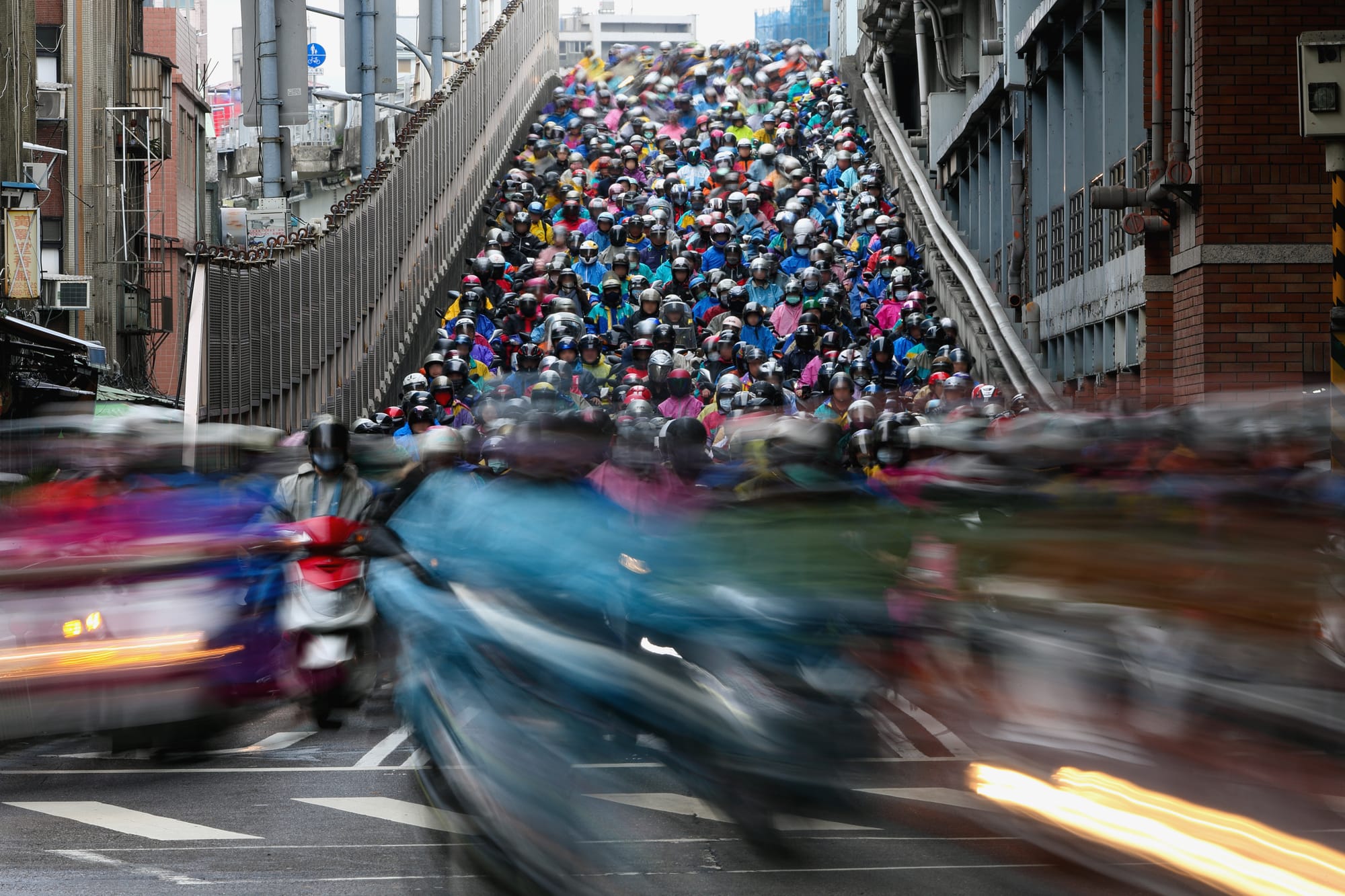
So the stakes at the casino are set: if they win, they reign over more scooters and become the first institutional scooter operator in Taiwan, where a waterfall of scooters is its greatest natural water landscape. Because scooters are "metals protected by humans", a Taiwanese idiom, and it would be super cool for an evil company, whose whole purpose is to be the middleman of everything, to control a lot of metals and command a lot of humans to protect them. Imagine the scene in the board room with sinister laughter, that would be an absolutely fulfilling climax of the board members' lives. But what if Uber loses?
The answer: Uber simply cannot lose. As CNA points out, the fine for Uber to illegally run a riding service is up to NT$25m, about US$785k. It's merely 0.016% of Uber's selling and marketing expense in 2025, which was US$4.898b, according to the company's report. And today, every major outlet in Taiwan reported the evil cultural experience program for free, including BobaChair (as an aspiring major outlet), and many sent reporters to actually test the services. In the worst case scenario, Uber pays NT$25m for a very successful marketing campaign and no one has actually fined the company yet.
Moreover, this program lacks the real cultural context in a way it's insulting to the term "culture experience". According to a Taiwanese pro-Independence outlet SET News' report and screenshots, the experience requires users to order the service on a smartphone like all Uber services, calls itself "Electric Uber Scooter", and requires riders to use helmet liners. C'mon, the real stuff is neither of them, and the real uncle/aunty rider will feel you're mental if you wear a helmet liner.
BobaChair thinks using the word "mental" here undermines people with mental illnesses, but we can't find a better term here. And no, we don't believe there are many professional aunty riders.
The real culture experience here is actually for the rider who provided the service. Taiwan's public television points out that an illegal rider would be fined up to NT$200k, with their license and plate confiscated for up to 4 months. NT$200k is around 4.96 months' worth of Taiwan's median salary for a full-time worker. The implied experience Uber curated for a person who relies on their scooters to make ends meet here is that they get to try a life of 8.96 months without income. Per CNA's coverage, Uber used very poetic language to tell the riders they won't be compensated if fined. Way to go, Uber.
As for the forecast for the result of the bet: BobaChair isn't a professional financial advisor on any level, but Taiwan did fold by passing the law for "diverse taxis" after Uber facilitated gazillions of illegal taxi rides in 2019. Uber said it "blazed a trail" (披荊斬棘) to get it legalized at the time, and we can't wait to see how it's gonna blaze at the public sentiments, the laws, the culture and the people of Taiwan to win the grande prize it invented for itself at the casino it built this time.
Researched, handwritten, fact-checked, and finalized by a real human who was born and raised in Asia. Lightly edited by Claude Sonnet 5 Medium and ChatGPT 5.5 Medium to remove critical word and grammatical errors. The author is too sleepy to edit anymore...


